
Info Travelling time
What is the difference between “Schedule in HRM” and “Time report”?
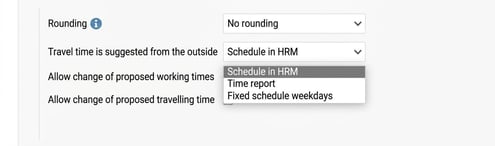
Schedule in HRM - means that regardless of how I have registered working time in my time report, my planned working hours will be proposed.
- For example, if I am scheduled 8-17 and have registered working time 7.30 - 17.05, my travelling time will still be based on 8-17.
Time report - means that the system uses the actual registered working hours in the time report.
- For example, if I am scheduled 8-17 but have registered working time 7.30 - 17.05, my travelling time will be calculated based on 7.30-17.05 instead of 8-17.
What does “Brakedown based to the schedule in HRM” mean?
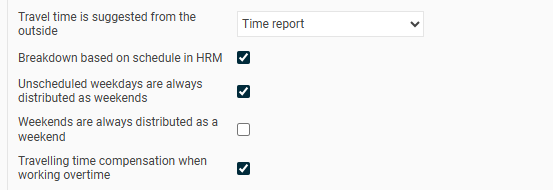
The division between pay code for workday and pay code for day off is done according to the Schedule in HRM Time. This is useful if an employee temporarily works on a day off and should then receive travelling time compensation for travelling time on a day off.
What does “Unscheduled weekday are always distributed as weekends” mean?
This means that if I register travelling time on a non-scheduled weekday, I will still receive weekend compensation.
What does “Weekends are always distributed as a weekend" if ticked mean?
This means that if I am scheduled to work on a Saturday or Sunday, I will still receive weekend compensation. If it is unticked, I will receive weekday compensation for Saturday and Sunday.
What does “Travelling time compensation when working overtime” mean?
If you activate this option, it means you also receive travelling time compensation for the hours worked as overtime.
- For example, if I work overtime on a Saturday between 8-9 and register travelling time between 7-10, I will receive travelling time compensation for 3 hours.
- If it is not activated, you will only receive 2 hours.
- Please note that this only applies if the time code is of the type Attendance - Overtime, Additional time, Comp. in. It does not work if you use the time code for normal working hour ARB.
Please note: This article is AI-translated. This means that linguistic errors or misunderstandings may occur.