
In-depth information on how the data is generated
Below you will find detailed information on what is included in the data for parts A and B, as well as how it is calculated.
Which employees are included in the data?
For an employee to be included in the data, the following is required:
- The employee must have held an employment during the reporting period.
- Contractual working hours and work measurements must be entered in the employee register.
- For employees who lack agreed weekly working hours, such as on-demand employees, you can enter 0% contractual working hours. For these employees, there must instead be a pay code with hours worked (see below).
If necessary information is missing for an employee, they are excluded from the calculation and instead shown in a separate warning list in the view as illustrated below.
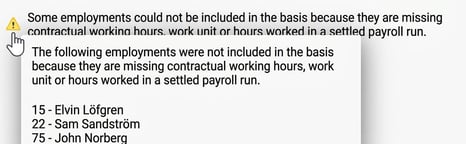
A – Employees
The calculation of the different parts is done one month at a time within the selection period. After that, an average is calculated over the whole period.
We start from the employee’s contractual working hours. If this is set to 0%, we calculate the contractual working hours each separate month based on hours worked and full-time measurement as follows.
Contractual working hours = Hours worked / Full-time measurement * (52.292/12)
- Number of hours worked is summarised per month from pay codes marked with the check box Level and structure of labour costs (LCS) – Actual worked time. The summary occurs per transaction date. If the transaction has no date, it is counted as belonging to the payroll run’s discrepancy period.
- The number 52.29 is the average number of weeks per year, taking leap years into account, according to the SCB instruction.
A.1 – Average number of employees
Summary of A.2 and A.3
A.2 – Average number of full-time employees
An employee is counted as a full-time employee if they have had a contractual working hours of 100% during all employment days within the reporting period. Someone employed full-time for half the year is counted as 0.5 full-time employees.
A.3 – Average number of part-time employees
Someone who has been employed all year and worked part-time during some part of the year is counted as 1 part-time employee. Someone employed part-time for half the year is counted as 0.5 part-time employees.
A.4 – Number of part-time employees recalculated as full-time persons
Someone employed at 50% for the whole year is counted as 0.5 full-time persons. Someone employed at 50% for half the year is counted as 0.25 full-time persons.
B – Hours
The figures under B.1 and B.2 are divided into full-time employees and part-time employees according to the same principle as in section A above.
The figures for section B are also calculated for each month separately and then summarised for the entire reporting period.
B.1 – Number of actual hours worked
Number of hours worked is summarised from pay codes marked with the check box Level and structure of labour costs (LCS) – Actual worked time. The summary occurs per transaction date. If the transaction has no date, it is counted as belonging to the payroll run’s discrepancy period.
If no hours worked have been registered as above, the calculation of hours worked per month is instead done as follows.
Full-time measurement * (A.2 or A.4) * 52.29/12 + Overtime/On-call hours – Absence hours
Overtime/On-call hours are summarised from pay codes marked with the check box Level and structure of labour costs (LCS) – Overtime/on-call.
Absence hours are summarised from pay codes marked with any of the check boxes Level and structure of labour costs (LCS) – Paid absence and Unpaid absence.
B.2 – Number of paid hours
If hours worked are registered on a pay code, paid hours are summarised per month as follows:
Hours worked + Paid absence
If not, the calculation is instead done as follows:
Full-time measurement * (A.2 or A.4) * 52.29/12 + Overtime/On-call hours – Unpaid absence hours
Related articles:

Level and structure of labour costs (LCS) – How do I generate statistics for LCS in HRM Payroll?


Level and structure of labour costs (LCS) – Which settings do I need to be able to retrieve statistics for LCS in HRM Payroll?
Please note: This article is AI-translated. This means that linguistic errors or misunderstandings may occur.