
Deduction for qualifying period from 1 January 2019
On 1 January 2019, the qualifying day was abolished and replaced by a deduction for the qualifying period. The purpose of this change was to ensure that the deduction made when an employee is ill is fair and predictable.
It is primarily the payroll system that is affected by these changes. Below you can read about how to manage the process in HRM Time. If your company doesn’t pay unsocial working hours for sickness, you don’t need to do anything in HRM Time.
Settings in HRM Time
As of the change on 1 January 2019, it is necessary to be able to send unsocial working hours to payroll even on the first day of sickness. Therefore, from version 182.14 and 183.3 onwards, the setting Give only unsocial working hours on days 2-14 has been changed. You can configure this per company (Time reports), time group (Time groups > Folder Time) or employee (Personnel > Folder Time).
The setting is now a dropdown menu with four options.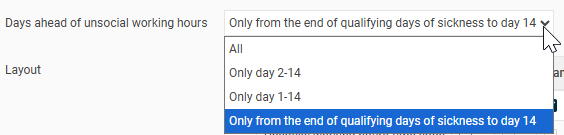
- All corresponds to previously having the setting unticked.
- Only day 2-14 corresponds to having it ticked.
- Only day 1-14 is used to send unsocial working hours even on the first sick day, but not after day 14.
- Only from the end of the qualifying period to day 14(see below for further description).
Only from the end of the qualifying period to day 14
The option Only from the end of the qualifying period to day 14 means that Flex HRM will calculate how many hours the qualifying period covers by taking the employee’s actual working hours per week from the Employee register divided by 5.
Example
An employee who has 40 hours/week working hours and 75% contractual working hours will get 40 * 0.75 / 5 = 6 hours.
This means that no unsocial working hours will be given for the first 6 hours of the sickness period. Note that these hours may be distributed over several days if, for instance, the employee is only scheduled to work 4 hours on the first day of sickness.
Related articles:
Why does unsocial working hours for sickness apply after day 14?
Please note: This article is AI-translated. This means that linguistic errors or misunderstandings may occur.