
A setting that can be configured per employee, timegroup or for the entire company controls which days in a period of illness should have unsocial working hours.
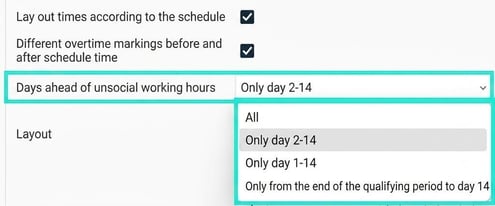
The image above shows the options you can select for the setting "Days ahead of unsocial working hours":
- All: Unsocial working hours apply to all days in a period of illness, regardless of its length.
- Only day 2-14: Sick leave unsocial working hours are removed from the first day and from day 15 onward.
- Only day 1-14: Unsocial working hours are removed from day 15 and onward.
- Only from the end of the qualifying period to day 14: Sick leave unsocial working hours are removed from the first 20% of weekly working hours and from day 15 onward. The qualifying period is the actual number of working hours per week divided by 5.
In HRM Time, unsocial working hours are initially generated according to the unsocial working hours- regulations for all sick leave, regardless of the setting and number of days. Every night a job runs to remove unsocial working hours from the reviewed days that should not have them.
A check is also performed during payroll transfer. If you have reviewed the time report on the same day as the payroll run, the nightly job has not yet been executed. In that case, unsocial working hours are removed during the transfer to payroll.
This is also checked during payroll transfer. If the time report has been reviewed on the same day as the payroll run, the nightly job hasn't run yet. Then unsocial working hours are removed when transferred to payroll.
Related articles:
Read more about time report setting levels
How is the deduction for qualifying period handled in HRM Time?
How do unsocial working hours- regulations work?
How do I set rules for unsocial working hours for sick leave?
Please note: This article is AI-translated. This means that linguistic errors or misunderstandings may occur.